Monday, May 17, 2010

Y: The Last Man Vol. 4 - Safeword


Y: The Last Man Vol. 4 - Safeword
By Brian K. Vaughan and Pia Guerra

My first time through Y: The Last Man, I was disappointed in this story arc. It seemed a needless distraction. A brief stall in the forward momentum the story had built over the course of the three previous volumes.

In re-reading it, my opinion hasn't changed much, expect that this time around I have a much greater appreciation for this volume's strong character development, and one aspect of this so-called "distraction" actually leads to a pretty significant character moment in the final installment of the series.

Volume 4 actually collects two short story arcs. The first deals with the world's last man, Yorick Brown, being captured by an S&M crazed woman, tortured to sexual frustration, insulted, and degraded. Only it's not what it seems. The second has our protagonists dealing with a small militia blocking supplies from reaching the west coast, with tragic results for all involved.

Neither does much to advance the core narrative. That might be a slight frustration, since we're eager to discover the causes of the plague that killed all men and to see if it can be reversed. However, both end up being vital to our understanding of who these people are, especially Yorick himself, whose devotion to a woman he hasn't seen in years (and who might not even been alive) seems selfish and short-sighted given the state of the world. The first story gets us inside his head, the second is a turning point for how he handles the insanity he faces in a world where every living male but him has died. These insights are pretty valuable in a grand scheme kind of way, even if they do interrupt the momentum of the overall story.

And they do.

Safeword is a lesser installment in a fantastic series. One that arguably can be skipped (though I wouldn't recommend it) despite what it delivers for the characters. Yet one that is still better than 90 percent of the comics out there.

And that's good.

Read my regular, everything-and-anything (usually on writing and music) blog right over here.

Friday, May 14, 2010

Y: The Last Man Vol. 3 - One Small Step


Y: The Last Man Vol. 3 - One Small Step
By Brian K. Vaughan and Pia Guerra

The awesome. There is so much of it!

So. Much. Awesome.

Like, all the dudes are dead and society as we know it is on the verge of collapse, women are doing their best to hold things together but there are crazy violent cults, rogue governments, and all sorts of Bad Stuff taking place, so it's all pretty horrible and stuff, right?

Then crazy and hilarious and sexy (and did I mention hilarious?) Russian woman is on the scene, and she says, hey, International Space Station, right? Two men are alive up there. They're on their way down. Men. Real men. And in a world where all the men have died but one, this is a Good Thing.

But these rogue Israeli agents don't like that. A living man, you see, would be a vital political and military resource. They can't be allowed to fall into the wrong hands, especially not a rival nation. So these men must be either taken into custody or destroyed.

Cue a race against time with guns and shootings and astronauts and funny Russian chicks and a really emotional ending.

First time I read Y: The Last Man, this ranked among my favorite arcs. It still does. It's the high point of the first half of the 60-issue, 10-volume series, bringing to fruition a few stories built up since the first issue while also spinning off new story arcs and new concerns for the people living in a post-man world. Great stuff. If you've read to this point and still aren't hooked, just bail out.

Also, hang your head in shame.

Read my regular, everything-and-anything (usually on writing and music) blog right over here.

Tuesday, May 11, 2010

Y: The Last Man Vol. 2 - Cycles


Y: The Last Man Vol. 2 - Cycles
By Brian K. Vaughan and Pia Guerra

So we've got Yorick Brown, the last living male on Earth (if you don't count his monkey, Ampersand). He's train-hopping across the country with "355," government secret agent tasked with protecting him, and Dr. Allison Mann, who has data in San Fransisco that might hold the key to why all males died and maybe, just maybe, to re-starting the human race.

Thing is, it wouldn't be much of a story if their travels were easy. And they're not. Being tailed by Israeli agents is pretty. Worse are the man-hating "Amazons," which include Yorick's sister, Hero. But first is an unexpected stop in Marrisville, Ohio, where a group of secretive women seem to have carved out a small utopia for themselves.

Even at this early juncture, writer Brian K. Vaughan walks a delicate tightrope by presenting stories that seem to meander away from the overall narrative -- finding the cause of the man-killing plague and some way to begin rebuilding the human race -- while also providing key milestones in both story and character development. The stop in Marrisville makes for a good drama, but how vital is it to the overall story?

Pretty damn vital, actually. Even aside from getting to know Yorick and his neuroses a little better, it marks a major turning point for his sister, Hero, and cements the Amazons into place as a bunch of cult crazies everyone despises.

Plus, you know, it's just a damn good story. The action doesn't stray into silly action movie territory, the drama is tense, the writing is smart and funny, and Pia Guerra's art is near perfect. The second in the brilliant trilogy of collections that open this series is a winner.

Read my regular, everything-and-anything (usually on writing and music) blog right over here.

Friday, May 7, 2010

Y: The Last Man Vol. 1 - Unmanned


Y: The Last Man Vol. 1 - Unmanned
By Brian K. Vaughan and Pia Guerra

I'll confess up front that I'm a little biased going into this post. First, I've already read Y: The Last Man in its entirety. I followed the series as it was first released in collected editions. Hung on every new chapter. Loved it.

So yeah, I'm going into this series of posts already a huge fan.

But a week or two ago when I sat down to reread Brian K. Vaughan and Pia Guerra's epic saga about a world in which all men die from a mysterious plague -- all but one, that is; wise-cracking, sexually dysfunctional escape artist Yorick Brown is the lone male on a planet full of females -- I figured it might be a kick to reassess my love for the story and see how well it holds together a little more than two years after it wrapped up.

So far, so good. So very, very good.

I forgot how rapidly Vaughn jumps into it. He wastes no time with needless buildup. On page one, BOOM, men are dying. Just a few pages in and half the population of the globe is dead. We meet Yorick, get to know what an unusual yet likable guy he is; see his wants, needs, and desires; then we're off and running. In no time at all we're seeing crumbling governments, post-apocalyptic anti-man cults, and glimpses of how life goes on without men in the picture. (How? Uneasily. But it does.) Yorick is out on the road trying (and failing) to keep his gender a secret. Conspiracies abound. Plot lines that take 50 or 60 issues to unwind are seeded. The crumbling pieces of a society in ruins struggle to put themselves back together.

It's heady stuff.

It's also terrifically fun and funny. Despite the rather grim and provocative subject matter, Vaughn takes a humorous and entertaining approach whenever possible, but without sacrificing the seriousness of the book's conceit. Even when the thematic material veers towards the heavy-handed, it's tempered with the kind of self-aware humor a story like this NEEDS if it's going to last. Maybe it was this ability to balance heavy themes, wild science fiction premises and sharp humor that lead to his being drafted as a writer for the television show Lost.

Bottom line is this: Y gets off to a rousing start, one so damn good that if you're not hooked with this first collection, you have no soul. Because damn, what a bloody brilliant ride this is.

Read my regular, everything-and-anything (usually on writing and music) blog right over here.

Thursday, December 10, 2009

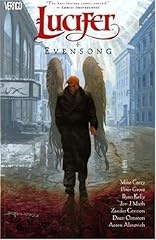
Lucifer Vol. 11 - Evensong


Lucifer Vol. 11 - Evensong
By Mike Carey, Peter Gross, & Ryan Kelly

And so Mike Carey's acclaimed series comes to a close. Please allow me to cut to the chase: No, Lucifer is not the second coming of Sandman (though to Carey's credit, I'm sure that was never his intention; he forged his own path). Yes, it may have been overpraised. No, it's not at all bad, though at times it's disappointing. Yes, it is good, and at times very good indeed.

Lucifer was an uneven experience, burdened by storytelling problems noted in other posts and a clear case of filler-itis. Between this and Volume 10, however, it ends on a strong note. As expected, this was an extended coda. Character arcs come to a close, the story reaches an end -- yet one that feels like a beginning -- and all that stuff set into motion so long ago is wrapped up nice and tight, turning Lucifer into a neat little package.

I liked it. With caveats.

The inclusion of a 48-page one-shot at the end of the volume does feel out of place, though. It's an okay story, nothing special, but that's not the problem here. It's the placement. Being placed after the final issue feels wrong somehow. The series' grand saga ends on a great note and then, oops, one more thing to read. It takes away from the power of the saga's end.

Overall, though, I find myself forgetting my earlier misgivings and walking away from Lucifer very satisfied. This last volume has some fine little stories and does a good job of closing the door on the series.

Sure, Lucifer wasn't quite the foray into brilliance many have said -- it was an inconsistent reading experience, its excellent highs often marred by muddy, boring lows -- but looking at the big picture, the total package is worth praising thanks in large part to an excellent close. Carey pulled it together in the end. Had the last two volumes not done such a good job of retroactively making all that came before relevant and worthwhile, I'd suggest a pass on this series. Instead, I'd say this is worth reading if you like the magic/religious/mythology wing of the Vertigo Building (which I do), just as long as you know it's at times inconsistent.

And none of this is to suggest that Mike Carey is anything less than a real talent, because let me tell you, when this guy is on, he's ON.

An earlier version of this review was originally posted at IMWAN.com.

Read my regular, everything-and-anything (usually on writing and music) blog right over here.
Tuesday, December 8, 2009

Lucifer Vol. 10 - Morningstar


Lucifer Vol. 10 - Morningstar
By Mike Carey, Peter Gross, & Ryan Kelly

Oh, how you frustrate me, Mike Carey. This wasn’t supposed to be brilliant. It wasn’t supposed to be good. It wasn't supposed to be wonderful. But it was.

How you frustrate me.

I was ready to stop reading this series. Bored, uninterested, no longer “feeling it.” Its uneven pacing and the holding pattern that was Crux finally pushed me near the bailing point. And then Morningstar comes along and I find myself in love with all things Lucifer. How did this happen? How can you have turned around something that was spinning off the rails into Overpraisedville? How can you have rescued it and made it great? Yes, GREAT.

This, the tenth volume in Carey’s Sandman spinoff, is a brisk, involving look at the climactic clash between heaven, hell, the Lilim, and various other factions. God is gone. The universe is dying. And Lucifer, the Fallen Son, the Lightbringer, the Morningstar, wants to save it. Thing is, a dozen other factions have their own aims in mind. A slew of other stories are ready to intersect. Amazingly, Carey managed to weave all these threads together into a functioning whole.

No, more than a functioning whole. A dynamic, dramatic, damned good whole.

If Crux was an unmoving bore and little more than an extended setup, this was an extended climax. Characters fight and die. Stories set into motion 40, 50, 60 issues prior come to a head. Stuff you hated earlier suddenly seems worthwhile. And the resolution to things … it actually makes sense! Not only do you buy it, looking back it appears as if it was part of the plan all along. It’s the natural end to the stories Carey was telling.

Damn. I was not expecting this.

So, one more volume to go. I expect it will be an extended coda wrapping up a few character arcs and stuff. But for now ...

Sheesh. Against all hope, he pulled it together in the end. He really did! This was awesome.

An earlier version of this review was originally posted at IMWAN.com.

Read my regular, everything-and-anything (usually on writing and music) blog right over here.

Thursday, December 3, 2009

Lucifer Vol. 9 - Crux


Lucifer Vol. 9 - Crux
By Mike Carey, Peter Gross, & Ryan Kelly

I wanted to sit down and write this post about as much as I want to finish this series at the moment. Which is to say, not at all.

Crux, one of the final arcs of Mike Carey’s acclaimed Lucifer, is hardly an arc at all. It’s an extended setup and little more, putting in place the pieces of the puzzle necessary for the final showdown between the forces of Heaven, the Lilim, and whatever other baddies Carey wants to throw into the mix, but doing little else more.

So yeah, I feel like I don’t have a damn thing to say about it. It ends at pretty much the same place it began. God is gone. Lucifer is gone. The Silver City is under siege. It started there. A few chess pieces were shuffled. It ended there.

That’s about it. Booooo-ring.

I’d honestly like to offer at least some intelligent commentary, but Crux offers very little to comment upon. It left me with no impression, good, bad or indifferent. It was just sort of there. Lifeless. Forgettable. Uninteresting.

:yawn:

An earlier version of this review was originally posted at IMWAN.com.

Read my regular, everything-and-anything (usually on writing and music) blog right over here.

Tuesday, December 1, 2009

Lucifer Vol. 8 - The Wolf Beneath the Tree


Lucifer Vol. 8 - The Wolf Beneath the Tree
By Mike Carey, Peter Gross, & Ryan Kelly

God is gone, gone, gone, so Fenris, the wolf of Norse mythology, decides now is a good time to end the world. Such is the core story of the eighth volume of Mike Carey's epic Sandman spinoff, Lucifer. This volume also features two one-shot stories.

'is all right, though it felt kind of like a retread of the last arc. Monsters from mythology see an opening in God's absence and try to take advantage of it. Lucifer, for reasons that are his own, forms an uneasy alliance with the angels (in this case his brother archangel, Michael), and races to stop them. Big Event happens at the end, one I'm sure will impact the last three volumes of this book. The end.

There is also a weird and off-putting subplot about a schizo who bludgeons his wife and young son to death with a hammer. It's part of the main story, but it feels forced, it doesn't quite fit, and it's kind of ugly.

However, the opening story, a standalone called "Lilith," is pretty damn good. It's a double-sized for the book's 50th issue and serves as an origin of sorts for both Lilth and Lucifer. Fantastic stuff.

The other standalone story is moody and interesting, but pointless. It's about ... ahhh, who cares what it's about? When you're this deep into a series-long saga, tossing in one-shots is risky unless you've got Neil Gaimain-like short story chops. Carey is good -- at times really damn good -- but I feel like this energy would have been better spent getting the core series in order.

At this point I'm looking forward to finishing this series, not because I'm eating it up, but because I'd like to see how things resolve and get it behind me.

An earlier version of this review was originally posted at IMWAN.com.

Read my regular, everything-and-anything (usually on writing and music) blog right over here.

Thursday, November 26, 2009

Lucifer Vol. 7 - Exodus


Lucifer Vol. 7 - Exodus
By Mike Carey, Peter Gross, & Ryan Kelly

By now, it’s clear to me that Mike Carey’s critically-acclaimed Lucifer series is something of an uneven experience. When it’s a good, it’s quite good indeed and surely worthy of praise. And when it’s not, it’s a well-intentioned mess.

Exodus, at least, falls into the former category. It’s a fairly focused work with a clear tale to tell – two, actually – and a clear arc that doesn’t leave you scratching your head.

So that’s good.

Though Exodus is made up of two separate stories, they’re connected in theme. God, you see, has left heaven. We don’t know where he went. He’s God. I guess he can go wherever the hell he wants. But anyway, he’s gone, and that’s Bad, because it means that his creation (as in the whole damn universe and everything connected to it) will slowly start to fall apart and die. Lucifer doesn’t want this to happen. Why? He has his reasons.

In the first story, ancient immortal creatures steal God’s power and try to take the throne of heaven. They can’t handle all that power, of course, giving Lucifer an opportunity to join ranks with the angles and stop them. For reasons that are his own.

It’s a decent little tale, especially fun for the uneasy tension between the always arrogant Lucifer and the even more arrogant angels.

In the second story, Lucifer decides that all immortal beings need to get the heck out of the realm he created (which won’t be affected when God’s realm dies, natch). He gathers up the folks who went on that magic boat ride from Mansions of the Silence, and instructs them to start kicking folks out. This arc is presented as a series of quirky fairy tales, seemingly unrelated at first but eventually merging into a larger story. There are some really swell high points here, especially the Puppet Show Of Gruesome Evil (my title). Essential to the overall narrative? Maybe not. But very enjoyable nonetheless.

This series continues to baffle the hell out of me. It has moments of pure excellence, then stretches of directionless blah, and then comes back to brilliant.

Yet I keep reading.

An earlier version of this review was originally posted at IMWAN.com.

Read my regular, everything-and-anything (usually on writing and music) blog right over here.

Tuesday, November 24, 2009

Lucifer Vol. 6 - Mansions of the Silence


Lucifer Vol. 6 - Mansions of the Silence
By Mike Carey, Peter Gross, & Ryan Kelly

Mansions of the Silence is a volume-long saga that pretty much amounts to an epic journey through strange and bizarre sights in, like, a totally epic and strange and bizarre dimension. It's writer Mike Carey's chance to pull out a dozen odd ideas and toss them onto the page. There are no rules, just do anything. Show anything. Make it a wild and crazy trip.

Well, it was indeed a wild and crazy trip. Did the story work? For the most part. At the core of the quest is an effort to bring back a character we grew to like in earlier volumes, so that at least helps draw us in. She's one of the few characters we ever really care about in Lucifer; I wanted to see her come back. You will, too.

On the other hand, this whole volume is almost all supporting cast. The titular fallen angel is the driving force of the story in spirit only; he's almost never on screen. He's busy with other stuff. You know, bugging angels or whatever. What a bastard.

It all wraps up with a I Have No Idea What Just Happened, which is frustrating because the ship on the cover? Cool. Some of what happens to our VERY awesome supporting cast? Cool. But the villains? Don't know, don't care. And the resolution? Don't know, don't care.

This is a repeated problem in the series. Carey has good ideas and at times his prose can really sing, but too often his stories are scattered, murky and indirect. Stuff seems to just happen, and it's hard to tell why or what it all means.

And it's not a matter of trusting the reader. I like writers who trust their readers. I admire the trait. This is not that. this is a pure storytelling issue.

Mansions of the Silence serves as a bridge between the initial major arc, concerning the Basanos, and the second major arc, concerning God's abandonment of heaven. It's the halfway point of the series and the link between the first half (a saga of its own) and the second half (a saga of its own). So yeah, you kind of have to get through it.

Decent enough stuff, but certainly not a high point in the series.

An earlier version of this review was originally posted at IMWAN.com.

Read my regular, everything-and-anything (usually on writing and music) blog right over here.

Thursday, November 19, 2009

Lucifer Vol. 5 - Inferno


Lucifer Vol. 5 - Inferno
By Mike Carey, Peter Gross, & Ryan Kelly

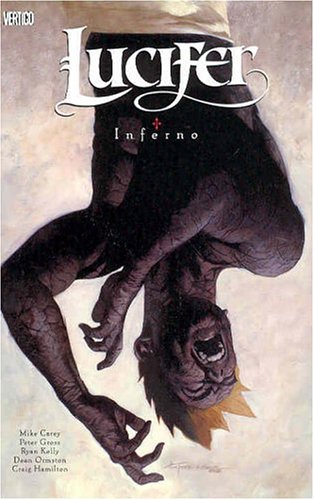
The rise and fall in quality of this series ... it gets frustrating. It does. Just when you think writer Mike Carey is hitting his stride, just when you think you're going to understand all the accolades thrown his way because he just gave you a heaping helping of AWESOME, you get a mixed bag of great ideas and adequate execution. Such is the case with Inferno, which seems to slap together the end of Vol. 4 and the start of Vol. 6. By all rights, it shouldn't exist as its own volume.

Inferno picks up where The Divine Comedy left off, plunging Lucifer into Hell so he can confront a rival angel. It's a fine enough four-part story with some solid plot surprises, but the pacing stinks and the art is pretty bland. What is it about Vertigo fill-in artists that makes them so often wrong? Sad that the fantastic tale started in the previous volume ends like this.

(As a side note, I'm coming to find that uneven pacing is a repeated quirk of this series. When it's good, it's fine, but sometimes Carey gets into spurts where he is changing scenes on every page and can't quite nail down a satisfying flow.)

A one-shot sits in the middle of this volume, and it. Is. Outstanding. Absolutely outstanding. One of the best issues of the series. Dean Ormston does the art, and it rocks. Carey tells a nifty side story, and it rocks. The issue rocks. The whole thing rocks.

Did I mention it rocks?

Then it's into a two-party that is really just a prologue to Vol. 6 (Mansions of the Silence). The art is back up to speed, there is some very clever stuff happening, and Carey picks up a few storylines set aside prior to this volume. By the look of things, the next volume will be great, delving into Norse mythology and bringing the full supporting cast together for an epic journey.

But that's next volume. Infernoone is what we're dealing with here, and it is, sadly, a mixed bag.

An earlier version of this review was originally posted at IMWAN.com.

Read my regular, everything-and-anything (usually on writing and music) blog right over here.
Tuesday, November 17, 2009

Lucifer Vol. 4 - The Divine Comedy


Lucifer Vol. 4 - The Divine Comedy
By Mike Carey, Peter Gross, & Ryan Kelly

Outstanding.

Mike Carey's grand epic about the fallen angel Lucifer finally lives up to its potential, delivering a gripping story about Lucifer's Creation, a bold attempt to take it from him, and another Fall.

What's not to like about this? The art is sharp, the storytelling crisp and clear, and the story itself is nothing short of dynamite.

Carey uses the conceit of Dante Alighieri's Divine Comedy in reverse, opening with the three-part Paradiso, which depicts the grandness of Lucifer's rebellious creation, then steering into the three-part Purgatorio, during which Lucifer's own folly comes back to haunt him and he is cut off from that which he created. Standalone stories bridge the gaps between each section. (Inferno gets its own volume in Vol. 5 of this series.) Much of what previously laid groundwork explodes in this set of story arcs, including stuff going way back to the first few issues. Important supporting characters see some major action here, some of them changed in big ways.

But most impressive here is how much Carey's writing -- the raw prose -- has improved from the first volume or two. Finally he's able to tangle with Neil Gaiman, from whose Sandman series Lucifer leapt. The writing is rich, at times beautiful, but never shows off. It's always in the right voice, depending on viewpoint, and very well done.

Epic and wonderful, this is the stuff that made me want to read this series in the first place.

An earlier version of this review was originally posted at IMWAN.com.

Read my regular, everything-and-anything (usually on writing and music) blog right over here.

Thursday, November 12, 2009

Lucifer Vol. 3 -- A Dalliance with the Damned


Lucifer Vol. 3 -- A Dalliance with the Damned
By Mike Carey, Peter Gross, & Ryan Kelly

Spotty and uneven. Missed opportunities. Flashes of excellence. Inconsistent. That's A Dalliance with the Damned.

For this volume to have a story as strong and interesting as the one in which Lucifer creates his own Garden of Eden and his own Adam and Eve is a shame, because the rest of it just doesn't rise to that story's level of excellence.

A few semi-standalones, such as the aforementioned Eden story, open up the volume, and they are, as noted, uneven at best. When they are good, they're outstanding, and when they're not they are entirely forgettable. (I can't even remember them now, and I only read them a few days ago.)

A three-parter set in hell feels like a space-filling diversion. Sure, the idea of a demon of hell taking a fancy to one of the damned is interesting, but we really don't care about the human character, and we certainly don't care about the political drama of the demons. Worse still, when Lucifer finally shows up in his own book, it's bland. About the only redeeming quality of this tale is that the human character may end up being interesting when all is said and done. Time will tell.

The final story is ... eh. What the hell was the point of the two human characters introduced here? Is it so we could see that Lucifer is a bastard? So that we don't get to like him too much? Whatever.

At least it ended on a nice cliffhanger that will hopefully set up some decent stories going forward.

An earlier version of this review was originally posted at IMWAN.com.

Read my regular, everything-and-anything (usually on writing and music) blog right over here.

Tuesday, November 10, 2009

Lucifer Vol. 2 - Children and Monsters


Lucifer Vol. 2 - Children and Monsters
By Mike Carey, Peter Gross, & Ryan Kelly

As with the first volume in Mike Carey's epic Lucifer series, the second volume contains two story arcs (2.5?) between its covers. They pick up where the first left off. Lucifer, as a reward for completing a task for God, has been given a gateway to an untouched void; a brand new realm in which there is nothingness; a place outside of creation.

This is, I guess, a big, big deal, because everyone wants it. And by everyone I mean EVERYONE, including the angels of Heaven, who are ready to mass an attack on Lucifer in order to get control of the gateway.

So Lucifer has some problems.

First we get Lucifer trying to regain his wings, which were torn off at his request in the pages of Sandman. This chapter has a nice Asian influence, cracking art and some good twists. It feels like a divergence, but it's an important step in building Lucifer back to the character he was before he left Hell.

Later we get some muddy stuff about an immortal girl and some such, a tangent that had me backtracking once or twice to be sure I was following the story. (As I will come to discovered later, this is not unusual for this series.)

And finally, we get the angels' attack on Lucifer's LA club, Lux, an attack that manages to take all that came prior (including in the first volume) and bring it full circle. Nifty stuff, and ultimately some very smart storytelling by Carey. He uses a number of elements introduced earlier, including some that seemed mere throwaways, and brings them into play for a rousing story.

All in all, Carey's writing is very good, at times excellent, and his plots are relatively strong. I have an issue with clarity, though. Maybe it's just me, but I at times find myself flipping back to double check on details from earlier stories or reminding myself who and what certain characters are. The art is fine, nothing to write home about, but it gets the job done.

Is this up to Sandman's level? Not after the first two volumes, no, not really. But then, what is? If the series improves for the third volume, it will be well on its way to excellence on its own terms. And really, that's the best thing a good comic can aspire to.

An earlier version of this review was originally posted at IMWAN.com.

Read my regular, everything-and-anything (usually on writing and music) blog right over here.

Thursday, November 5, 2009

Lucifer Vol. 1 - Devil in the Gateway


Lucifer Vol. 1 - Devil in the Gateway
By Mike Carey

It goes without saying that most efforts to match Neil Gaiman's now legendary Sandman are destined to fall short of the mark. It also goes without saying that in writing a spinoff to Sandman, Mike Carey ended up in the unfortunate (and at times unfair) position of having his comic be relentlessly compared to Gaiman's landmark series.

And yes, I am going to further poke at the wound in this series of blog posts.

Two arcs (one from a miniseries) and a single issue make up the opening trade in the 11-volume Lucifer series, which is based on the portrait of Lucifer painted in the Sandman arc Season of Mists. Are the stories collected here any good?

Yes, they are good. Not great, but certainly good.

In the opening arc, Lucifer, who abandoned hell in aforementioned Sandman arc, is given a task to do. A task from God. The big guy has a problem, you see -- elder gods mucking with humanity in a bad way, and this will cause Big Problems -- so he goes to Lucifer to take care of the matter. An odd choice. Wonder what God is up to?

The watercoloured art in this first arc is great. The concepts are interesting, if vague, and the dialogue largely rings true. The resolution falls a bit flat, however, though it does feel as if it sets up future events. (As of this reading, I don't know if that's the case, but I assume so.) All in all, s solid start.

The second arc sort of picks up where the first left off, and involves a deck of cards filled with ... I dunno, spirits or demons or something. Carey obviously had some neat ideas he wanted to play around with, but I felt like this arc was unrefined and unfocused. You could see where he wanted to go, the themes with which he wanted to play and the ideas he wanted to seed, but it didn't quite click. A noble effort, to be sure, and certainly not bad, but clearly too early for Carey to start hitting his stride.

Not a bad start. I look forward to Vol. 2, in which (I'm pretty sure) the series' regular artist comes on board.

An earlier version of this review was originally posted at IMWAN.com.

Read my regular, everything-and-anything (usually on writing and music) blog right over here.

Monday, August 10, 2009

The Essential Fantastic Four - Vol. 1


Essential Fantastic Four – Vol. 1
By Stan Lee and Jack Kirby

(covering issues 1-20, Annual 1)

It wouldn’t be entirely true to say the Fantastic Four hit the ground running. In fact, the opposite is true. Unlike the Amazing Spider-Man, Stan Lee and Jack Kirby were clearly trying to find their way in the first days of this legendary book. The concept and characters were works in progress. Ideas were being tweaked right there on the page. What we have here is a book in an embryonic state, with some characterization – the Thing especially – a far cry from what would later be established as “real.”

But flawed as they are (and they are), they’re sure a heck of a lot of fun to read.

Stan and Jack took a good 10 issues or more to really hammer into place what would be the core of the book. It wasn't even clear at first that they had something decent on their hands. Lots of adventure and imaginative ideas right off the bat, yes, but some of them were laughable -- The Thing as the historical Blackbeard the Pirate made me groan -– plus ugly inks and an unrefined Kirby make the silly stories visually unappealing. It’s not until the end of this volume that you begin to see Kirby’s strengths show themselves (though his storytelling skills are strong from the start) and the book itself to begin to gel.

But even with the uneven quality of the initial stories, he and Stan tossed out some terrifically fun ideas, mixing pulp science fiction with the early 1960s version of “realistic” superheroes. These early FF books exist in a nice place where they can be unabashedly pulp, with a dose of the grandiose, and plenty of good-natured fun. Sure, some of the stuff is downright goofy but taken in context and with a grain of salt, you could also argue that they’re a hoot.

Some things to note: Ben Grimm betrays Reed and Johnny, casting them into the sea to drift away and die, and the Thing uses a nuke – a NUKE! – to destroy a giant monster right in the middle of a populated city!

If it sounds like the Thing is different than the one you know, it's true. He is. And what a jerk! One of my favorite Marvel characters, so boy was it eye-opening to see how different he is here. Scheming, plotting, and full of honest to god disdain for his teammates. I was pretty surprised at how humorless and mean he was in his first appearances. A totally different character. Not even likable in the slightest. Rather than being the huggable curmudgeon we know and love, he was ... well, a creep.

It's hard to call the very first stretch of Fantastic Four essential reading. I had fun with them. As a historic curiosity they're certainly of interest. But if the truth be told, Stan and Jack don't starting hitting their legendary stride until partway through the second volume of these black and white reprints.

Read my regular, everything-and-anything (usually on writing and music) blog right over here.

Wednesday, August 5, 2009

The Essential Amazing Spider-Man – Vol. 1


The Essential Amazing Spider-Man – Vol. 1
By Stan Lee and Steve Ditko

(covering Amazing Fantasy #15, Amazing Spider-Man #1-20, Annual #1)

The Amazing Spider-man is one of the world's most recognizable characters, matched in comics books only by the likes of Superman and Batman. He is an icon. An icon that has lasted for over 45 years and shows no sign of losing popularity. But was he cool even when he was introduced way back in 1962? The Essential Amazing Spider-Man – Vol. 1, which collects the original issues in an affordable black and white volume, is a great way to find out.

The answer? It was genius from the start. I wasn’t sure how well this would hold up, but it’s a home run, plain and simple. There is nothing not to like. (Except the Enforcers.)

Unlike the Fantastic Four, which in 1961 got off to an awkward and unsteady beginning, the Amazing Spider-Man hit the ground running and was a fun read from the very first issue. Sure, Peter Parker is kind of a jerk in the first two issues (his fight with the Vulture in issue #2 happened because Peter was trying to snag some money), but that’s part of what I like. From the start, Spider-Man and Peter Parker were evolving as characters, and they evolved in a very natural way.

It’s interesting to see this embryonic version of Spider-Man, having previously read only the origin and first issue, maybe a few others. Some core elements, like Flash Thompson and J. Jonah Jameson, are in place from the start, but other stuff we now consider essential – Gwen Stacy, Mary Jane, the Osbornes, etc. – are absent. Nifty, that. Goes to show you that Spider-Man is a character built upon an ever-changing status quo. Much more so than any other Marvel title at this time, Spider-Man was built as an ongoing saga that continued from issue to issue. Such is the case even today.

Though out of date by today's standards, Stan Lee’s writing is whimsical and fun. As much as I want to groan at it, I get a real kick out of the constant “the Marvel Age of Comics!” hype. Rather than off-putting, it's charming and endearing.

Adding to this is Steve Ditko’s art, which was a delight. I hadn't taken real notice of his work before, so this was eye opening. His quirky figures and expressive characters make Spider-Man stand out from the cookie-cutter comics of the era.

The steady stream of classic villains helps this collection reach great heights of totally awesomeness. So many iconic characters in just the first batch of issues! (Well, okay, there was a dud or two. I could do without ever seeing the Enforcers again. GOOFY!)

Aside from some really silly diversions, like the awful “Living Brain” issue, this stuff holds up remarkably well. It’s easy to see why readers were so excited by it and why Spider-Man was (allegedly) an instant hit. I LOVE the way Ditko lets the action unfold, and LOVE the way Lee gets us right into Peter's head.

It's a multi-generational hit, too. I gave my copy to my son after I was finished reading it, and he devoured the stories – in random order, of course, just like a kid should – and has since read it two or three times.

Even forty-five years later, this is top shelf fun.

Read my regular, everything-and-anything (usually on writing and music) blog right over here.

Tuesday, July 14, 2009

Planetary Vol. 3 - Leaving the Twentieth Century


Planetary Vol. 3 - Leaving the Twentieth Century
By Warren Ellis and John Cassaday

Sign that you're reading something that will stand the test of time: It just keeps getting better as you go on.

On the surface, Leaving the Twentieth Century isn't all that different from the two volumes that came before it, All Over the World and The Fourth Man. This is a collection of six stories, each a standalone foray into Warren Ellis' giddy blend of 1950s science fiction, 1990s superheroes, Twilight Zone episodes, 1980s Alan Mooreisms, and 1940s pulp.

We've got a visit with an ancient Sherlock Holmes. A wicked science fiction twist on Marvel's Thor mythology. Explosions of Asian and Australian aboriginal fable. A new take on Captain Marvel aka Shazam. And the works of Edgar Rice Burroughs and Jules Verne contorted into something entirely new.

Clearly, Ellis delights in showings us the familiar dressed in new clothes.

The clothes look better than ever, too. John Cassaday's art has improved dramatically since the first volume. Not sure if it's the inking or coloring or a new approach or a heavier hand with Photoshop or what, but things look just outstanding here. His knack for laying out a page and offering dramatic visuals just EXPLODES here with awesome landscapes and big, expansive shots that could have been pulled out of a David Lean film. Great stuff.

And naturally, these six stories continue to inject small dozes of larger mythology into the series. Things are clearly leading up to some larger confrontation. Some bit o' finality. Yet Ellis never succumbs to the lure of continuity, that great and burdensome beast at whose throne so many comic writers (and fans) worship. Despite having such a deep, rich backstory and mythology, Planetary is a surprisingly light read. You can read any single Planetary story and enjoy it on its own terms. You don't need to unravel a web of who what when where how whys. You don't need to know what happens in issue #312 (second series, not the 1960s original) of the spinoff title featuring the supporting character who now leads his own team, only it's not really him it's the clone featured in last year's epic crossover event. He avoids that trap, and by doing so makes Planetary like a little more awesome than it already is.

Modern comic writers should be taking notes.

Read my regular, everything-and-anything (usually on writing and music) blog right over here.

Thursday, July 2, 2009

Planetary Vol. 2 - The Fourth Man


Planetary Vol. 2 - The Fourth Man
By Warren Ellis and John Cassaday

When I first settled in to read Planetary Vol. 1, I did not know what to expect, I only knew that my expectations weren't high. Though I liked a good deal of the Warren Ellis work I had read, his work on the edgy-and-epic The Authority left me cold. For whatever reason, I had the impression that Planetary was a kindred spirit to The Authority.

Turns out they're nothing alike. For one, Planetary is awesome whereas The Authority isn't.

But I digress.

After reading volume one, the reader gets the distinct impression that there is a larger story at work here. Sure, each of the six issues in that collection was a standalone, but each also dropped a little hint at a broader tapestry. Secret histories. Character backgrounds. Conspiracies. A bigger story. It was not unlike Hellboy in that respect.

Though again dishing out an array of six unique standalone stories, The Fourth Man makes clear that Planetary absolutely has a larger narrative, and that if we keep reading we're going to peel back all sorts of interesting layers from this big, tasty onion. Even moreso than the superb quality of these tales -- these six almost all knock it out of the park and to a story are better than the first volume's -- it is the idea that something larger is at work that has me eager to keep reading.

Which isn't to say the stories wouldn't still be awesome as a series of one-shots, because damn are they good. Ellis takes all sorts of geeky cool stuff like '50s sci-fi movies and classic superhero comics and more, shoves handfuls of magic mushrooms down their throat, and turns them into something familiar yet alien. It's like an bad dream, only it's an awesome bad dream from which you never want to wake. A killer twist on those giant insect movies, complete with Red Scare secret government projects. What would really happen to the Justice League arose in a dark and sinister world of conspiracies. Snow coming to realize who and what he is.

This is wall to wall great.

Consciously or not, word of mouth that is too good often results in me scoffing, sometimes even hoping to dislike Flavor of the Moment. All that gushing and fawning and "you've got to read this!" makes me a bit ill, like when you drink too much and then have a five-egg omelet and then try to swim the English Channel. And with the final issue of Planetary announced just before I started reading this, the buzz was building. I was ready to break out the Pepto. Sickness time approached.

But it passed. I get it. Planetary is, like, really good and stuff. So, like, I totally get it. 'Cause it's awesome.

Read my regular, everything-and-anything (usually on writing and music) blog right over here.

Wednesday, June 24, 2009

Planetary Vol. 1 - All Over the World


Planetary Vol. 1 - All Over the World
By Warren Ellis and John Cassaday

Warren Ellis is something of a polarizing figure in the world of comics. A writer who doesn't hide his disdain for traditional superhero stories and who has cultivated an online community is, to put it mildly, a bit prickly, Ellis has nonetheless built a resume that ought to earn respect from all but the most old school, it's-got-to-have-tights-or-it-ain't-comics readers. He has worked in classic science fiction (a genre too infrequently seen in modern comics), risque political and social commentary, horror, action/adventure, and more -- and it's almost always been worth reading. His least interesting work tends to be his traditional superhero stories.

His most acclaimed achievement in comics might be the four-time Eisner Award nominated Planetary, his long-running collaboration with artist John Cassaday. Tough to tell, though, since it's been so s l o w to come out. Though it began way back in 1999, it took them 10 years to release a mere 26 issues. (The 27th and final issue is due out in October 2009).

But with all the accolades this series has received, one has to ask, has Planetary been worth the wait? Is it time for me to take the plunge?

Having only just started to read it, I'm prepared to answer with a solid YES.

Planetary is kind of a superhero book, but only just barely. In fact, I'd be hesitant to categorize it that way, though many people do. Sure, it features people with amazing abilities doing amazing things, and often doing so while where tight and/or colorful costumes, but at heart it's a modern version of pulp science fiction through and through.

Oh yeah, the premise. Yeah, I guess you need to know that. "Planetary" is a secretive organization devoted to investigating amazing events and "the secret history of the 20th Century." The three investigators, funded by a mysterious "fourth man," trot around the globe (or dimensions, or universes) and pretty much do interviews and take notes. Once in a while they save the world.

This volume brings together six stories that give you a good idea of what they do, but even more importantly, provide a window into all the amazing worlds Ellis and Cassaday are going to show us. It probably wouldn't be far fetched to suggest that Ellis conceived of Planetary in part as an excuse to do whatever the hell he wanted to do in a comic, because this thing is all over the map. Even in just these first six issues we get Twilight Zone sci-fi, monster movie mysteries, superhero romps, and more. Whatever pops into his head that day.

Though each story stands on its own just fine, they each take subtle steps forward in uncovering a larger mythology, too. That might be what's most exciting about Planetary. The individual stories here are imaginative and wonderful (often not-so-veiled homages to characters and concepts Ellis clearly loves, such as Godzilla or 1960s superhero origin stories), but they each serve as a tiny part of a jigsaw puzzle. Minuscule piece by minuscule piece, we get the sense that something bigger is at work. A conspiracy, and a mystery, and maybe a threat to the planet. Something that may end up unfolding over the course of the entire series. And that's pretty awesome.

Heck, this whole damn thing was pretty awesome. Not super awesome like I'm Ready To Tell The World That This Is The Best Thing Ever awesome, but certainly This Made For A Good Night Of Reading Imaginative Comics awesome.

Though I could be wrong, I get the sense that a wild ride is ahead.

Read my regular, everything-and-anything (usually on writing and music) blog right over here.