Tuesday, July 14, 2009

Planetary Vol. 3 - Leaving the Twentieth Century


Planetary Vol. 3 - Leaving the Twentieth Century
By Warren Ellis and John Cassaday

Sign that you're reading something that will stand the test of time: It just keeps getting better as you go on.

On the surface, Leaving the Twentieth Century isn't all that different from the two volumes that came before it, All Over the World and The Fourth Man. This is a collection of six stories, each a standalone foray into Warren Ellis' giddy blend of 1950s science fiction, 1990s superheroes, Twilight Zone episodes, 1980s Alan Mooreisms, and 1940s pulp.

We've got a visit with an ancient Sherlock Holmes. A wicked science fiction twist on Marvel's Thor mythology. Explosions of Asian and Australian aboriginal fable. A new take on Captain Marvel aka Shazam. And the works of Edgar Rice Burroughs and Jules Verne contorted into something entirely new.

Clearly, Ellis delights in showings us the familiar dressed in new clothes.

The clothes look better than ever, too. John Cassaday's art has improved dramatically since the first volume. Not sure if it's the inking or coloring or a new approach or a heavier hand with Photoshop or what, but things look just outstanding here. His knack for laying out a page and offering dramatic visuals just EXPLODES here with awesome landscapes and big, expansive shots that could have been pulled out of a David Lean film. Great stuff.

And naturally, these six stories continue to inject small dozes of larger mythology into the series. Things are clearly leading up to some larger confrontation. Some bit o' finality. Yet Ellis never succumbs to the lure of continuity, that great and burdensome beast at whose throne so many comic writers (and fans) worship. Despite having such a deep, rich backstory and mythology, Planetary is a surprisingly light read. You can read any single Planetary story and enjoy it on its own terms. You don't need to unravel a web of who what when where how whys. You don't need to know what happens in issue #312 (second series, not the 1960s original) of the spinoff title featuring the supporting character who now leads his own team, only it's not really him it's the clone featured in last year's epic crossover event. He avoids that trap, and by doing so makes Planetary like a little more awesome than it already is.

Modern comic writers should be taking notes.

Read my regular, everything-and-anything (usually on writing and music) blog right over here.

Thursday, July 2, 2009

Planetary Vol. 2 - The Fourth Man


Planetary Vol. 2 - The Fourth Man
By Warren Ellis and John Cassaday

When I first settled in to read Planetary Vol. 1, I did not know what to expect, I only knew that my expectations weren't high. Though I liked a good deal of the Warren Ellis work I had read, his work on the edgy-and-epic The Authority left me cold. For whatever reason, I had the impression that Planetary was a kindred spirit to The Authority.

Turns out they're nothing alike. For one, Planetary is awesome whereas The Authority isn't.

But I digress.

After reading volume one, the reader gets the distinct impression that there is a larger story at work here. Sure, each of the six issues in that collection was a standalone, but each also dropped a little hint at a broader tapestry. Secret histories. Character backgrounds. Conspiracies. A bigger story. It was not unlike Hellboy in that respect.

Though again dishing out an array of six unique standalone stories, The Fourth Man makes clear that Planetary absolutely has a larger narrative, and that if we keep reading we're going to peel back all sorts of interesting layers from this big, tasty onion. Even moreso than the superb quality of these tales -- these six almost all knock it out of the park and to a story are better than the first volume's -- it is the idea that something larger is at work that has me eager to keep reading.

Which isn't to say the stories wouldn't still be awesome as a series of one-shots, because damn are they good. Ellis takes all sorts of geeky cool stuff like '50s sci-fi movies and classic superhero comics and more, shoves handfuls of magic mushrooms down their throat, and turns them into something familiar yet alien. It's like an bad dream, only it's an awesome bad dream from which you never want to wake. A killer twist on those giant insect movies, complete with Red Scare secret government projects. What would really happen to the Justice League arose in a dark and sinister world of conspiracies. Snow coming to realize who and what he is.

This is wall to wall great.

Consciously or not, word of mouth that is too good often results in me scoffing, sometimes even hoping to dislike Flavor of the Moment. All that gushing and fawning and "you've got to read this!" makes me a bit ill, like when you drink too much and then have a five-egg omelet and then try to swim the English Channel. And with the final issue of Planetary announced just before I started reading this, the buzz was building. I was ready to break out the Pepto. Sickness time approached.

But it passed. I get it. Planetary is, like, really good and stuff. So, like, I totally get it. 'Cause it's awesome.

Read my regular, everything-and-anything (usually on writing and music) blog right over here.

Wednesday, June 24, 2009

Planetary Vol. 1 - All Over the World


Planetary Vol. 1 - All Over the World
By Warren Ellis and John Cassaday

Warren Ellis is something of a polarizing figure in the world of comics. A writer who doesn't hide his disdain for traditional superhero stories and who has cultivated an online community is, to put it mildly, a bit prickly, Ellis has nonetheless built a resume that ought to earn respect from all but the most old school, it's-got-to-have-tights-or-it-ain't-comics readers. He has worked in classic science fiction (a genre too infrequently seen in modern comics), risque political and social commentary, horror, action/adventure, and more -- and it's almost always been worth reading. His least interesting work tends to be his traditional superhero stories.

His most acclaimed achievement in comics might be the four-time Eisner Award nominated Planetary, his long-running collaboration with artist John Cassaday. Tough to tell, though, since it's been so s l o w to come out. Though it began way back in 1999, it took them 10 years to release a mere 26 issues. (The 27th and final issue is due out in October 2009).

But with all the accolades this series has received, one has to ask, has Planetary been worth the wait? Is it time for me to take the plunge?

Having only just started to read it, I'm prepared to answer with a solid YES.

Planetary is kind of a superhero book, but only just barely. In fact, I'd be hesitant to categorize it that way, though many people do. Sure, it features people with amazing abilities doing amazing things, and often doing so while where tight and/or colorful costumes, but at heart it's a modern version of pulp science fiction through and through.

Oh yeah, the premise. Yeah, I guess you need to know that. "Planetary" is a secretive organization devoted to investigating amazing events and "the secret history of the 20th Century." The three investigators, funded by a mysterious "fourth man," trot around the globe (or dimensions, or universes) and pretty much do interviews and take notes. Once in a while they save the world.

This volume brings together six stories that give you a good idea of what they do, but even more importantly, provide a window into all the amazing worlds Ellis and Cassaday are going to show us. It probably wouldn't be far fetched to suggest that Ellis conceived of Planetary in part as an excuse to do whatever the hell he wanted to do in a comic, because this thing is all over the map. Even in just these first six issues we get Twilight Zone sci-fi, monster movie mysteries, superhero romps, and more. Whatever pops into his head that day.

Though each story stands on its own just fine, they each take subtle steps forward in uncovering a larger mythology, too. That might be what's most exciting about Planetary. The individual stories here are imaginative and wonderful (often not-so-veiled homages to characters and concepts Ellis clearly loves, such as Godzilla or 1960s superhero origin stories), but they each serve as a tiny part of a jigsaw puzzle. Minuscule piece by minuscule piece, we get the sense that something bigger is at work. A conspiracy, and a mystery, and maybe a threat to the planet. Something that may end up unfolding over the course of the entire series. And that's pretty awesome.

Heck, this whole damn thing was pretty awesome. Not super awesome like I'm Ready To Tell The World That This Is The Best Thing Ever awesome, but certainly This Made For A Good Night Of Reading Imaginative Comics awesome.

Though I could be wrong, I get the sense that a wild ride is ahead.

Read my regular, everything-and-anything (usually on writing and music) blog right over here.

Friday, April 24, 2009

Hellblazer - Rake At The Gates of Hell (Ennis Vol. 6)


Hellblazer - Rake At The Gates of Hell
By Garth Ennis, Steve Dillon

Not with a bang, but with a whimper.

Throughout Garth Ennis' stellar run on Hellblazer, he spent a lot of time building up a solid, ever-evolving story. Threw together many elements and made them work. Built towards what looked to be a remarkable confrontation with the devil himself. How would Constantine get out of the jam he was in? What amazing plan would he hatch? Could he once again pull the figurative rabbit out of the hat? It was thrilling to imagine the ways in which this could have played out.

Reading the finished product was less thrilling than the imagining.

Rake At The Gates Of Hell
is a solid, if unremarkable, final story arc, bringing to a close Ennis' (usually) fantastic Hellblazer run. I only wish it could have finished as strongly as it started, because when this run was good, it was OUTSTANDING. This, though, was just pretty good ... and that's it.

Sure, the writing remained crisp and lively. Yes, Steve Dillon's art continued to be beautiful in its simplicity and top-shelf in its storytelling.

Just didn't have the rousing finish a reader would hope to see, is all.

Oh yeah, and whose idea was it to cap things off with a lengthy, tedious double issue of talk, talk, talk, none of which had anything to do with Constantine or the core story? Stupid, stupid, stupid to place this special issue at the end of this volume. Bad call by DC's graphic novel editorial type people.

An earlier version of this review was originally posted at IMWAN.com.

Read my regular, everything-and-anything (usually on writing and music) blog right over here.

Wednesday, April 22, 2009

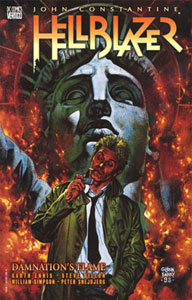
Hellblazer - Damnation's Flame (Ennis Vol. 5)


Hellblazer - Damnation's Flame
By Garth Ennis, Steve Dillon

So, Damnation's Flame. Or Damn Nation's Flame. Clever, huh? Little bit of subtle commentary, right? Goes right along with the whipsmart political and social commentary of the story, yeah?

No.

No, not clever, or subtle, or smart, or any such thing. It's not that Ennis' political commentary is offensive or wrong or anything like that. That's not the issue. The issue is that it's clunky and heavy-handed and so blindly obvious as to be insulting to the reader.

Look, JFK has a hole in his head! Look, Uncle Sam is an evil Devil guy! Look, people are eating one another in the streets! Yada yada yada and blah blah blah.

Whatever.

Again, it's got nothing to do with what Ennis is saying or the message he's delivering, it's got everything to do with how he's saying it. And how is "not very well." Clumsy and ham-fisted does not make for good political commentary.

I love Ennis' run on this title, I really do, but Damnation's Flame was a misstep from the word go. It was an adequate, and nothing better than adequate, step away from the overarching narrative Ennis had until this point been telling. Not necessary, and in retrospect not overly enjoyable, either.

An earlier version of this review was originally posted at IMWAN.com.

Read my regular, everything-and-anything (usually on writing and music) blog right over here.
Monday, April 20, 2009

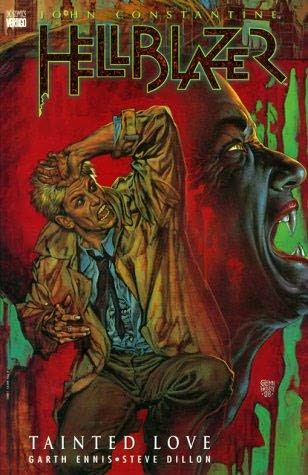
Hellblazer - Tainted Love (Ennis Vol. 4)


Hellblazer - Tainted Love
By Garth Ennis, Steve Dillon

This collection is a fine example of why Garth Ennis' run on Hellblazer is held in such high esteem. This does not collect an epic arc or grand story or any such thing. Rather, Ennis takes little bits of what came before and spins a handful of standalone-yet-connected stories that center on John Constantine and the people he knows.

And it's fantastic.

In a two-parter, we revisit the King of the Vampires from the Bloodlines collection in a surprisingly gruesome story. But gruesome isn't the point. The point is the broken state of Constantine's heart and mind. That the story springs from seeds planted much earlier only serves to make it better. Solid stuff.

In another story the focus is almost entirely on Constantine's lover, Kit. This is a great example of what Ennis does best -- build character. Sure, sure, he curses a lot and has scenes of graphic sex and violence, but at their core the best Ennis stories are about people, not shocking content. THAT'S why people loved Preacher so much. Not because of the sex and violence, but because we liked those characters so much. When he's on his game, few people do better "talking heads" comics.

"Finest Hour" is a decent little one-shot that has very little to do with Constantine, yet somehow manages to symbolize his struggle to overcome the despair he wallows in throughout most of this volume. It's a diversion, but one that resonates. A side story, yet one that works for the ongoing saga.

There is also a dark, disturbing one-shot from the Hellblazer Special featuring a madman priest, the devil, child abuse, and other friendly fellows. This one will make you shudder. A lot. Dire and wonderful stuff, this is.

This is, alas, Ennis' peak on Hellblazer.

Oh yeah, and did I mention it's fantastic?

An earlier version of this review was originally posted at IMWAN.com.

Read my regular, everything-and-anything (usually on writing and music) blog right over here.
Friday, April 17, 2009

Hellblazer - Fear and Loathing (Ennis Vol. 3)


Hellblazer - Fear and Loathing
By Garth Ennis, Steve Dillon

Garth Ennis' run on Hellblazer is respected for a reason. Because it's good. But it's no knock on Ennis to offer much of the credit to artist Steve Dillon, who jumps on board with this volume, and in doing so launches the book into the stratosphere. Ennis and Dillon would go on to have some great collaborations -- the beloved Preacher and Ennis' under-read Punisher run the two best -- but I'll always have a warm place in my heart for this one.

Dillon's entry into the Hellblazer fray is a Good Thing. Nay, this is a Great Thing, because his art is fantastic. Not fantastic in the big, bombastic way of glitzy comic artists and loud superhero books. His is a more controlled look. More focused. It's a bit busy and sketchy in these early issues (he loses the sketchy look partway through this run), but right out of the gate his main strength is apparent: He's a great, great storyteller.

And THAT, my friends, is a huge part of what makes him so great. Sure, his lines are attractive and he draws some of the most expressive faces in the business. A good thing, that, considering how talking Ennis-penned books can be. But the real key to his work is that he's a damn good storyteller, quite a rare thing these days. One can eliminate all the text from the page and yet still have a great sense for what's happening. His panels are clear. Never cluttered. Always direct.

Modern artists could learn a thing or two from Steve Dillon.

That artwork is attached to Ennis' best Hellblazer story to date. Here we've got Constantine making life very, very difficult for the angel Gabriel - and is there anything better than seeing this sour-pussed Englishman make like difficult for a snooty angel? I think not. Excellent stuff. Very well executed.

This volume also contains one of my favorite stories, John Constantine's 40th birthday party, which is warm and funny and features some fantastic guest appearances. Anyone up for smoking the Swamp Thing?

It's all being done with a purpose, too. One nice thing about Ennis' run is that everything seems to be built upon which came before, yet it rarely feels forced or as if Ennis is pushing around pawns for his plot. Instead, the overall tale builds in a very natural, character-driven way. I like that.

Great stuff.

An earlier version of this review was originally posted at IMWAN.com and was also featured at PopThought.com.

Read my regular, everything-and-anything (usually on writing and music) blog right over here.